
The Prioritization Tool That Actually Aligns Teams
Prioritization meetings take all day and nothing gets decided. ForceRank replaces circular debates with clear, data-backed priorities in 5 minutes.
Why prioritization meetings fail
If these sound familiar, your team needs a better process.
The loudest voice wins
Dominant personalities steer the conversation. Quieter team members disengage. Decisions reflect confidence, not insight.
Everything is "priority 1"
Without forced tradeoffs, stakeholders refuse to deprioritize anything. You end up with 20 "top priorities" and no real direction.
Groupthink kills honest input
Once the first opinion is voiced, everyone anchors to it. Independent judgment disappears.
Meetings drag on with no resolution
Two-hour prioritization meetings that end with "let’s take this offline" and a follow-up meeting next week.
ForceRank vs. other prioritization methods
There are many prioritization frameworks. ForceRank complements or replaces them by capturing honest team input with zero setup.
vs. RICE Scoring
RICE requires estimates for reach, impact, confidence, and effort. That means spreadsheets, guesswork, and hours of scoring. ForceRank captures intuitive team preferences directly — no spreadsheets needed.
vs. Eisenhower Matrix
The matrix sorts items into 4 buckets (urgent/important). ForceRank creates a precise priority order — no ambiguity about what’s #1 vs #2 within a bucket.
vs. MoSCoW Method
MoSCoW creates 4 categories (Must, Should, Could, Won’t). Force ranking creates a complete ordering, eliminating the "everything is a Must-Have" problem.
vs. Dot Voting
Dot votes can be split strategically across options. Force ranking captures the complete preference order from each participant, giving a richer and more honest signal.
How team prioritization works
Three steps. Five minutes. Clear priorities.
Create Your Prioritization
List the items your team needs to prioritize. Share the link — no accounts needed for participants.
Everyone Ranks Independently
Each team member drags items into their priority order on their own time. Anonymous mode available to eliminate bias.
See Team Consensus
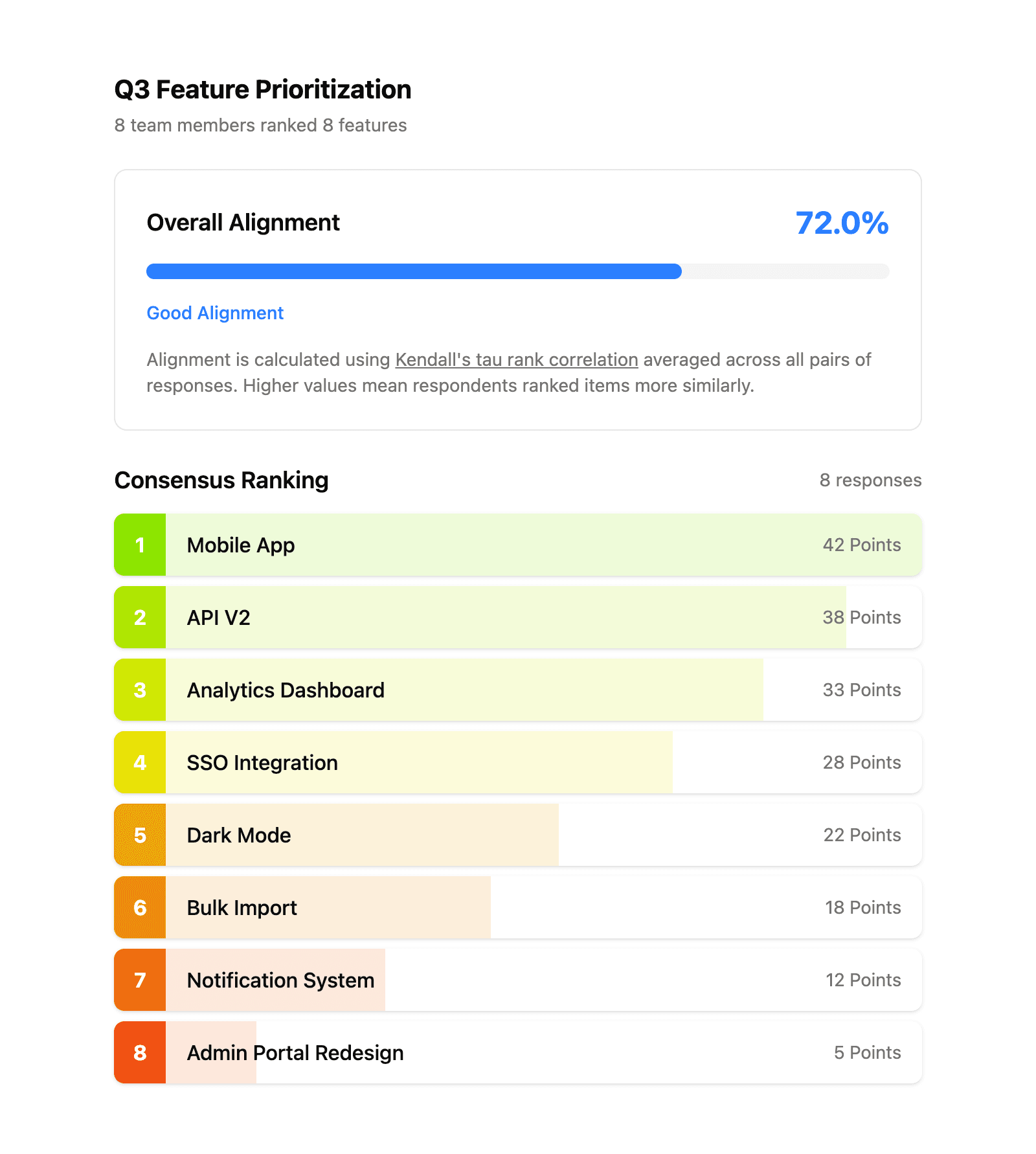
The Schulze algorithm produces the mathematically optimal group ranking. See where the team aligns and where they disagree.
Data-Backed Priorities, Not Opinions
ForceRank calculates the mathematically optimal group ranking and shows you exactly how aligned your team is.
Built for team prioritization
Every feature is designed to surface honest team priorities with zero meeting overhead.
Async Participation
No meeting required. Each person ranks on their own time. Results aggregate automatically.
Anonymous Ranking
Eliminates HiPPO bias. Everyone ranks independently without seeing others’ choices.
Consensus Visualization
See exactly where the team aligns and where they disagree. High-variance items become discussion points.
Schulze Algorithm
Mathematically optimal group ranking. Finds the option that would beat every other in a head-to-head comparison.
Teams use ForceRank to prioritize...
Annual Planning
Align on company priorities for the year ahead.
Product Roadmap
Decide which features to build next.
Sprint Planning
Get engineering consensus on sprint priorities.
Conference Topics
Let attendees vote on sessions they want.
OKR Objectives
Stack rank objectives for the quarter.
Budget Allocation
Force tradeoffs on spending priorities.
Hiring Criteria
Align on what matters in a candidate.
Team Retrospectives
Prioritize improvements across the team.
Want to see real examples? Browse sample rankings · Read our guide to annual planning prioritization
Teams that rank together, decide faster
“ForceRank was fantastic – we used it to prioritize our projects for the 2022 budget. It made the process transparent and got everyone aligned quickly.”

Matt Wojcik
VP of IT, US Radiology Specialists
“I love ForceRank. By virtue of its simplicity, it forces real prioritization decisions. No more "everything is priority 1" – you have to actually choose.”

Angela DeFranco
VP Product, SevenRooms
“ForceRank is an amazing tool. It helped us surface ideas and collaborate better as a team. The results view showed us exactly where we agreed and disagreed.”

Charles Tran
Founder, CreditDonkey
Frequently asked questions about team prioritization
- What is a team prioritization tool?
- A team prioritization tool helps groups agree on what matters most. Instead of debating in meetings, each person ranks items independently, and the tool calculates the group consensus. ForceRank uses force ranking — no ties allowed — so every participant commits to real tradeoffs.
- How is ForceRank different from a survey?
- Surveys let everyone rate things 5 out of 5, which produces flat, uninformative results. ForceRank forces each person to create a strict priority order with no ties. This reveals real preferences and makes disagreements visible.
- What prioritization framework does ForceRank use?
- ForceRank uses force ranking (also known as stack ranking) combined with the Schulze voting algorithm. Each participant creates a complete priority order, and the Schulze method aggregates them into the mathematically optimal group ranking.
- Can I use ForceRank for agile sprint planning?
- Absolutely. Many engineering teams use ForceRank to prioritize their sprint backlog asynchronously. Each team member ranks the stories independently, and the results show where the team agrees and where they need to discuss further.
- How do I handle disagreements the tool surfaces?
- ForceRank shows you exactly where the team disagrees — items with high variance in rankings. Use these as discussion points in your meeting. You will spend time debating the two or three items that actually matter, not rehashing the entire list.
- Is the prioritization tool free?
- Yes. Creating prioritization rankings is free, and participants never need to sign up. Paid plans add features like advanced analytics and custom branding.
Your next priority meeting could take five minutes
Create your first prioritization for free. No credit card required.
Free for everyone. No limits.