
Budget Prioritization
Every department thinks their budget is most important. ForceRank reveals where leadership actually aligns on spending priorities.
The Budget Allocation Problem
Budget discussions are among the most political conversations in any organization. Every department head arrives with a compelling case for why their area deserves more funding. The CEO tries to be fair. The CFO tries to be responsible. And the result is usually a compromise that spreads money evenly rather than investing heavily in what matters most.
The problem is not that people are selfish — it is that group budget discussions structurally reward advocacy over honesty. In a meeting, admitting that another department's budget is more important than yours feels like losing. So everyone fights for their share, and the budget ends up reflecting political skill rather than strategic priorities.
ForceRank's anonymous ranking removes the politics entirely. When each leader ranks spending priorities independently and privately, they can be honest about what they believe matters most — even if it is not their own department. The algorithm reveals the genuine consensus, giving leadership a data-backed starting point for allocation decisions.
How ForceRank Depoliticizes Budgets
List Spending Categories
Add the budget categories competing for funding — engineering, sales, marketing, R&D, infrastructure, and so on. Keep it to 6-10 strategic areas.
Anonymous Leadership Ranking
Share the link with the leadership team. Each person ranks spending priorities anonymously. No one sees who ranked what until results are revealed.
Data-Backed Budget Decisions
See the consensus priority order and disagreement map. Use the results to allocate budget proportional to actual strategic importance.
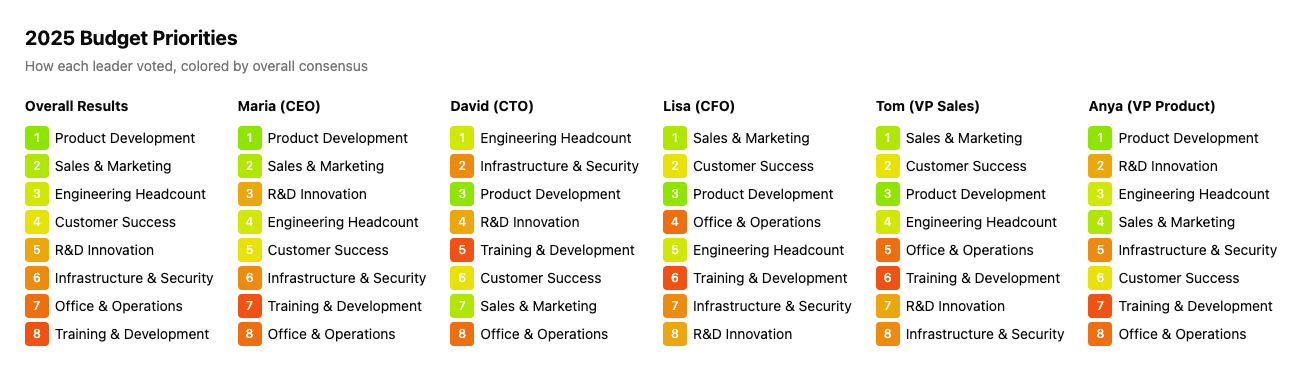
See Where Leaders Really Disagree
Each column shows how a leader ranked budget categories — colored by the group consensus. Red items ranked high means that leader disagrees with the team.
Try It: Rank Budget Priorities
Drag the items below to rank them in your order of priority.
Try it yourself — Rank 2025 Budget Priorities
Choices
Your Ranking
Budget Prioritization FAQ
- How does ForceRank help with budget decisions?
- ForceRank forces your leadership team to rank budget priorities in order — no ties allowed. This eliminates the common failure mode where every department gets equal funding because nobody wants to make hard tradeoffs. Each leader ranks the spending categories independently and anonymously, then the algorithm reveals the genuine group consensus. You walk into the budget meeting knowing exactly where leadership aligns and where they disagree.
- Should budget ranking be anonymous?
- Strongly recommended. Budget discussions are inherently political — department heads naturally advocate for their own budgets. Anonymous ranking removes this bias. When the VP of Engineering cannot be identified as the person who ranked sales expansion last, everyone ranks based on what they genuinely believe is best for the company. The results reflect honest priorities, not political positioning.
- Can I share results with finance?
- Yes. ForceRank results are shareable via a link. The results page shows the consensus ranking, individual response distributions, and areas of disagreement — all in a clean, visual format. Finance teams find this data valuable because it provides a data-backed rationale for budget allocation decisions, not just a political compromise.
- How granular should budget items be?
- Keep budget items at the category level rather than line-item level. "Engineering Headcount" is better than "3 Senior Engineers + 2 Junior Engineers + 1 DevOps." Aim for 6 to 10 spending categories that represent meaningful strategic choices. The goal is to force tradeoffs between broad investment areas, not to micromanage line items. You can always drill down into specific allocations after the top-level priorities are set.
Align Your Budget Priorities
Create your first budget ranking in under a minute. Free for everyone, no credit card required.