
OKR Ranking
You have 12 possible objectives. You can realistically pursue 4. ForceRank helps your team choose the right ones.
The OKR Prioritization Problem
OKR setting often produces too many objectives. Every team contributes their candidates, leadership adds strategic themes, and the result is 15 objectives that the organization commits to pursuing simultaneously. The predictable outcome: the team spreads thin, makes incremental progress on everything, and delivers nothing exceptionally well.
The root cause is that OKR meetings fail at the hardest part of the process: saying no. Cutting an objective feels personal — it means telling someone their priority does not make the cut. So teams avoid the hard conversation and commit to everything instead.
Force ranking OKRs surfaces the real priorities without the politics. When every participant independently orders the candidates from most to least important, the algorithm reveals what the team actually believes matters most. The result is an honest, data-backed priority order that makes the “which 4 do we pursue” conversation straightforward.
How ForceRank Prioritizes OKRs
List OKR Candidates
Gather objective candidates from across the organization. Include 6 to 12 options — more than you can pursue, so the ranking forces real tradeoffs.
Everyone Ranks Independently
Share the link with leadership and key contributors. Each person drags OKRs into their priority order. Anonymous mode ensures honest input.
Choose with Confidence
The Schulze algorithm reveals the top-ranked objectives and highlights disagreement. Pick the top 3-5 knowing they reflect real team consensus.
See How Everyone Voted
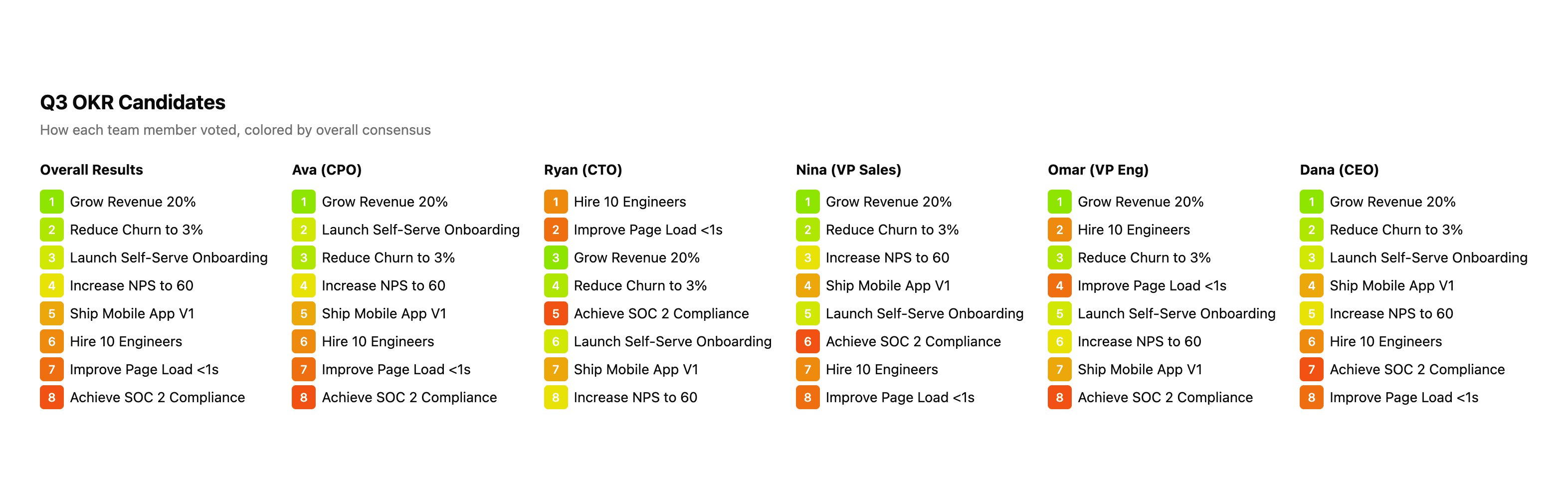
Each column shows one person's priority order. Items are colored by the group consensus — so red items at the top instantly reveal where someone disagrees with the team.
Try It: Rank OKR Candidates
Drag the items below to rank them in your order of priority.
Try it yourself — Rank Q3 OKR Candidates
Choices
Your Ranking
OKR Ranking FAQ
- How do I use ForceRank for OKRs?
- Start by listing the candidate objectives your team is considering for the quarter. These should be the 6 to 12 objectives that have already passed an initial viability check. Share the ForceRank link with everyone involved in OKR setting — leadership, team leads, and individual contributors. Each person ranks the objectives independently using drag-and-drop. ForceRank calculates the optimal group ranking using the Schulze method, showing you which OKRs the team truly prioritizes and where there is disagreement.
- Should leadership and ICs rank together?
- It depends on your goals. Ranking together reveals alignment (or misalignment) between leadership vision and IC ground-level reality. This is usually the most valuable approach. If you want to compare perspectives, create two separate rankings — one for leadership, one for ICs — and compare the results. The differences often surface important insights about strategy-execution gaps.
- How many OKRs should we rank?
- Rank 6 to 12 candidate objectives. Most teams can realistically pursue 3 to 5 OKRs per quarter. Ranking more candidates than you can pursue is the whole point — it forces the team to make real tradeoffs instead of committing to everything. If you have more than 12 candidates, do a rough first-pass to narrow the list before using ForceRank for the final prioritization.
- Can I use results in our OKR tool?
- Yes. ForceRank results are shareable via a link and can be easily referenced when entering your final OKRs into tools like Lattice, Ally.io, Weekdone, or a simple spreadsheet. The ranked list gives you a clear priority order to follow. ForceRank is the decision-making tool; your OKR tool is the tracking tool. They complement each other.
Rank Your OKRs
Create your first OKR ranking in under a minute. Free for everyone, no credit card required.